The short version
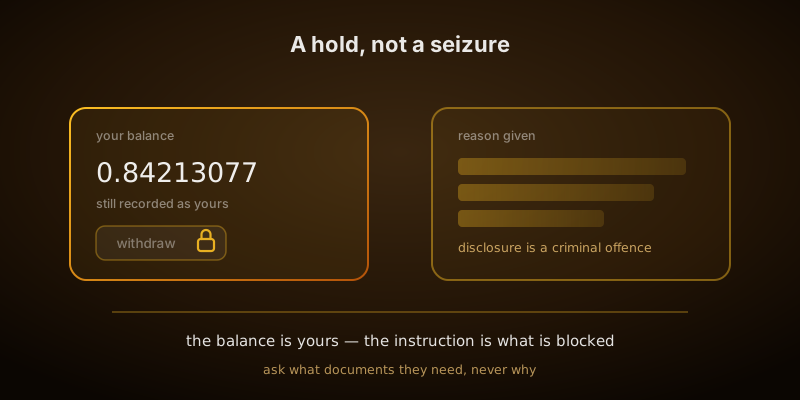
- A freeze is a hold, not a seizure. The balance is still recorded as yours and the firm is refusing to act on your instructions while a review runs. A seizure comes with a document you can read and challenge. If no document exists, you are in a hold — which is better news than it feels like.
- Nobody will tell you why, because in most countries telling you is a crime. Anti-tipping-off law forbids a regulated firm from disclosing that a suspicion report exists. The vague message is not evasion; it is the only lawful message available.
- The support agent genuinely does not know either. Suspicion reports are compartmentalised. Escalating your tone at someone with no access to the file changes nothing except the tone of the reply.
- A source-of-funds request is a documentary test, not a conversation. Bank statements, payslips, invoices, contracts, tax returns and verifiable transaction identifiers pass. A paragraph of background does not, however true it is.
- Where a statutory clock is running, the timetable is fixed. In the United Kingdom a consent request gives the authorities seven working days, and a refusal starts a thirty-one-day moratorium extendable by court to one hundred and eighty-six. No amount of asking shortens it.
- Regulators mostly do not adjudicate — they supervise. A complaint's real value is that it moves your case off the front line, creates a dated record, and imposes an internal deadline. In the European Union, MiCA makes the complaints procedure an obligation rather than a courtesy.
- Two moves make things materially worse. Opening a second account, and paying a recovery service. The first is evidence of evasion; the second is where advance-fee fraud does its best business.
- The structural fix is where your assets live, not which venue you pick. An exchange is a transit lane. Almost every serious freeze story is really a story about a balance that had no reason to be sitting there.
This is not legal advice. Freezes are governed by the law of wherever the venue is licensed, not wherever you live, and the procedures differ substantially between jurisdictions. This guide describes the mechanics that are common across most regimes as of 2026 and names statutory timetables where they are settled. Nothing here is a route around any obligation, and none of it will help anyone whose funds are genuinely the proceeds of crime. If a formal order, an allegation, or a sum you cannot afford to lose is involved, take qualified local advice early rather than late.
Four different things get called "frozen"
The first useful act is establishing which one you are actually in, because the four have different owners, different timetables and different remedies. Most people skip this step and spend the first week applying the wrong strategy.
- A full account restriction. You cannot log in, or you log in and everything is disabled. This is the firm's own risk decision, taken by its compliance function, and it is the one most likely to resolve on documents.
- A withdrawal-only restriction. You can log in, see balances, sometimes even trade, but nothing leaves. This usually means a review of a specific deposit or a re-verification cycle rather than a view about you, and it is often the fastest to clear.
- A hold on one deposit or one asset. The rest of the account works normally. This is almost always a screening score on the incoming transaction — a label attached to an address somewhere in its history, not a finding about you. The guide to flagged coins covers how those scores are built and why the same coins pass at one venue and fail at another.
- A legal freeze. A court order, an account freezing order, a restraint order, a seizure warrant, or a regulator's direction. The tell is that a document exists, even if you have not been shown it, and that the firm's language shifts from "under review" to something more careful. This is the only category where the firm genuinely cannot release funds however much it might want to, and the only one where a lawyer is not optional.
Read the exact wording of the notice rather than your memory of it. Check, concretely: can you log in, can you trade, can you move assets other than the flagged one, and has anything been returned to source. The combination of answers tells you which category you are in more reliably than anything support will say.
Why nobody will tell you why
The single most disorienting part of a freeze is the absence of a reason, and it is worth understanding that this is designed rather than accidental. When a regulated firm forms a suspicion about a transaction or a customer, it reports that suspicion to a financial intelligence unit. From that moment, telling the customer that a report exists — or that an investigation is being considered — is a criminal offence in most developed jurisdictions.
In the United Kingdom the provision is section 333A of the Proceeds of Crime Act 2002. It carries up to two years' imprisonment on indictment, and it does not require the firm to have intended any harm. The European anti-money-laundering directives impose an equivalent prohibition across member states, and in the United States the confidentiality attaching to a suspicious activity report does the same job in different words: the report, and its existence, cannot be disclosed to the subject.
Three consequences follow, and all of them are counter-intuitive:
- The unhelpful message is the compliant message. "Your account is under review in accordance with our terms" is not a corporate brush-off. It is close to the only sentence the firm's lawyers will permit, and a more detailed one would expose an employee to prosecution.
- The person answering you has not been told. Suspicion reporting is deliberately compartmentalised. Front-line support usually sees a flag and a scripted response, not a reason. Escalating your tone at someone with no access to the file is not merely unproductive — it produces a record of your conduct that sits in the same case notes a reviewer will later read.
- Not every silence is a suspicion report. Plenty of freezes are mundane — an expired identity document, a re-verification cycle, a mismatch between your declared activity and what the account actually did. Those can be explained, and often are, if you ask a question that has an answer.
So change the question. "Why have you frozen my account?" has no available answer and burns the review window. "What specific documents do you require, in what format, to complete this review?" has an answer, is lawful to give, and is the question the compliance team is waiting for someone to ask.
The eight things that actually trigger a freeze
Ranked roughly by how often they are the real cause, rather than by how often they are blamed.
- A deposit that scored badly. Screening software assigns a risk score to incoming funds based on labels attached to addresses in their history, and a score above the venue's threshold triggers a hold. The label may be several hops away and may have nothing to do with you. This is the most common cause by a wide margin, and it is covered in depth in the tainted crypto guide.
- A pattern the monitoring system flagged. Transaction monitoring is rule-based and does not know your circumstances. Rapid deposit-and-withdraw cycles, a sudden change in volume, a series of transfers just below a reporting threshold, or activity that does not match the profile you gave at sign-up all generate alerts. The structuring rule catches an enormous number of people who were simply moving money in convenient amounts — and it is worth knowing that deliberately arranging transfers to stay under a threshold is a separate offence in most regimes.
- A re-verification cycle. Identity documents expire, regulations change, and firms periodically re-run due diligence on their whole book. An unanswered re-verification request becomes a restriction, and the original email frequently went to a mailbox you no longer read.
- A sanctions or politically-exposed-person name match. Screening runs against lists with fuzzy matching, and common names generate false positives constantly. These usually clear quickly once a human compares a date of birth, but only after someone looks — and in a backlog, looking takes weeks.
- A counterparty data failure. Where the travel rule applies, a withdrawal to another regulated provider carries an identity payload that the receiving side must accept. When the two compliance systems cannot complete the handshake, the transfer stalls and the balance sits in limbo. This is a coordination failure between regulators presenting as a fault of yours; the travel rule guide explains the mechanism.
- A jurisdiction problem. Logging in from a country the venue does not serve, a VPN exit node in a restricted location, or genuinely moving abroad without updating your address can all restrict an account. Some venues restrict first and ask later, and the restriction can outlast the trip.
- A third-party report. Someone claims a payment to you was fraudulent, a bank recalls a transfer, a card issuer raises a chargeback on the fiat leg, or a victim of a scam names an address that later touched yours. The firm freezes pending resolution, and you may never learn which of these it was.
- A law-enforcement request or court order. The least common and the most serious. Here the firm is an instrument rather than a decision-maker, and the remedy is legal rather than administrative.
Notice how few of these involve any wrongdoing on your part, and how many of them are invisible from where you are standing. That asymmetry is the whole difficulty: you are asked to resolve a problem whose nature you are not permitted to be told.
What a source-of-funds request is really asking
If the review produces a request for information rather than a closure, it will almost always be a source-of-funds request, and it is the point at which most people lose weeks by misunderstanding what is wanted.
Two terms get used interchangeably and are not the same thing. Source of funds is narrow: where did this specific money come from, immediately before it arrived here. Source of wealth is broad: how did you come to have assets of this magnitude at all. The second is asked when the amount is large relative to the profile you declared, and it is a much heavier request — it reaches back years rather than weeks.
Both are documentary tests. The reviewer is not evaluating whether your account is plausible; they are assembling a file that has to satisfy an internal standard, survive an audit and, in a bad case, be handed to a regulator. Their question is not "do I believe you" but "can I evidence this". A perfectly true explanation with nothing attached fails that test, every time, and the failure is not a judgement about your honesty.
The underlying principle is chain of custody. Each hop from the lawful origin to the money in front of them should be evidenced by something a third party produced: an employer, a bank, a client, a counterparty, a tax authority, or a public ledger. Where a hop cannot be evidenced, say so explicitly rather than leaving a gap for the reviewer to fill with an assumption.
The genuinely hard cases are honest ones. Coins bought in 2015 from an exchange that no longer exists. A peer-to-peer purchase with no contract. Mining income from a pool that kept no statements. An inheritance handled informally. None of these is illegitimate and all of them are difficult to document — which is precisely why the record has to be made at the time, a point the tax guide makes for the same reason from a different direction.
The evidence that works, and the evidence that does not
What passes:
- Bank statements covering the relevant period, complete and unredacted, showing the outgoing payment that funded the purchase.
- Payslips, employment contracts, or client invoices matched to the deposits they explain.
- Tax returns or assessments. These carry disproportionate weight because a third party you cannot control has already accepted the figure.
- Statements or exports from the venue where the assets were originally acquired, even an old one, even a partial one.
- Transaction identifiers a reviewer can verify independently on a block explorer, with a one-line note on what each represents.
- Sale agreements, property completion statements, grants of probate, gift declarations — anything where a lawyer, notary or registry was involved.
What fails, and why:
- An explanation with no attachments. It cannot be filed, so it does not count as anything.
- Cropped screenshots. A screenshot proves nothing about a document's authenticity and cannot be reconciled to a date, a balance or an account number.
- Heavily redacted statements. Blacking out the very lines that would evidence the flow defeats the purpose, and it reads as concealment even when it is only privacy instinct.
- Spreadsheets built after the request arrived. A reconstruction is self-authored evidence; it is fine as an index pointing to real documents, and worth nothing on its own.
- Partial answers. Supplying eight of the ten documents asked for restarts the clock rather than advancing it, because the file is still incomplete.
Presentation matters more than it should. Send complete files in a standard format, named so that a stranger can tell what each is, one file per claim, with a short cover note mapping each document to each deposit and stating explicitly where a gap exists and why. Reviewers work through queues under time pressure; a package that can be assessed in one pass gets assessed in one pass. A pile of unnamed images goes to the back of the queue.
Never send a seed phrase, a private key, or a wallet password to anyone, for any reason, at any stage of a review. No legitimate verification process has ever required one. A signed message from an address, or a small test transaction, proves control without disclosing anything — and a request for the key itself is a compromise attempt regardless of how official the page looks. Frozen-account holders are a heavily targeted group; the scam guide covers how that targeting works.
What the timeline actually looks like
The useful distinction is whether the clock belongs to the firm or to a statute, because only one of them is negotiable.
An internal review runs on the firm's own timetable. A deposit-level hold or a re-verification usually resolves within days to about two weeks once the requested material is complete. A source-of-wealth review on a large balance takes longer, because it requires a senior sign-off that is scheduled rather than immediate.
A statutory process runs on a fixed timetable that nobody at the firm can shorten. The United Kingdom's version is the clearest to describe and a reasonable mental model for how these things work elsewhere: where a firm needs consent to proceed with a transaction it suspects involves criminal property, the request gives the National Crime Agency seven working days to respond. If consent is refused within that window, a thirty-one-day moratorium begins, during which law enforcement decides whether to act. A court can extend that moratorium in further blocks of up to thirty-one days, to a maximum of one hundred and eighty-six. Separately, since October 2023, firms have been able to pay away sums below one thousand pounds when exiting a customer relationship without needing consent at all — which is why very small frozen balances sometimes come back quickly and without explanation.
Other regimes have their own suspension clocks — a financial intelligence unit in an EU member state can typically halt a transaction for a short defined period, extendable by judicial order — and the United States has no equivalent automatic hold, so an American freeze is either the firm's own risk decision or a law-enforcement action with a document behind it.
Three practical implications:
- Silence in the first fortnight is normal. Uncomfortable, but normal. Chasing daily produces no information and consumes the goodwill you will want later.
- Silence past thirty days means something structural. Either a statutory clock is running or your ticket has stalled. Both are answered the same way: a formal complaint, which starts a different and documented timer.
- A precise deadline you were given is a good sign. It means a human has the file and a process is running. A repeated "no timeline can be provided" usually means neither.
The escalation ladder, in order
Each step exists because the previous one failed, and skipping steps weakens the next one — a regulator's first question is what the firm's final response said.
- Preserve everything, immediately. Screenshots of balances, the restriction notice, the complete ticket thread with timestamps, and a full transaction export while you can still generate one. Access is sometimes reduced during a review, and evidence you did not capture on day one can become unavailable exactly when a complaint needs it.
- Ask the one question that has an answer. What specific documents, in what format, are required to complete this review. Get it in writing. A support agent's verbal list is not a record.
- Submit a complete package, once. Everything asked for, properly named, with a cover note. Resist the urge to send documents in instalments as you find them; each partial submission tends to restart the assessment.
- Convert the ticket into a formal complaint at thirty days. Use the published complaints channel, not support. State the amount held, the dates, what was submitted and when, what you are asking for, and request a final written response. This is the pivot point of the whole process: it moves the case out of front-line handling into a function with reporting obligations, and it produces the document every later step depends on.
- Consider a data subject access request, where you have the right to one. Under the European and United Kingdom data protection regimes you can ask for the personal data a firm holds about you. It will not produce the suspicion report — that is exempt, and properly so — but it frequently surfaces account notes, review dates, and the fact that a process exists and has a status. It also imposes a statutory response deadline on a firm that has been ignoring your voluntary one.
- Escalate to the authority that supervises the venue. The right one is the regulator where the firm is licensed, not where you live. Expect supervision rather than adjudication, and send it anyway — the referral raises internal priority and builds the record.
- Escalate publicly, carefully, if the amount justifies it. A factual, dated, unemotional public account of a stalled case does sometimes reach a team that a ticket did not. Keep it accurate and keep it boring; exaggeration is what lets a firm dismiss the whole thing, and an account that reads as a threat invites a legal response rather than a resolution.
- Take legal advice when the arithmetic justifies it. A letter before action from a solicitor is a different object from an email. Above a few thousand units of your currency, or where an actual order exists, this is the step that matters — and it works better after the earlier steps have produced a paper trail than as an opening move.
Where to complain, by regime
Stated honestly, including where the answer is that there is no effective route.
- European Union. The strongest position of any regime. Since MiCA applied, a licensed crypto-asset service provider must operate a published complaints-handling procedure, make a template available, investigate fairly and respond within a reasonable period — with the detail specified in a 2025 delegated regulation. Complaints go first to the firm, then to the national competent authority that licensed it: BaFin in Germany, the AMF in France, the CNMV in Spain, Consob in Italy, the Central Bank of Ireland, and so on. The European supervisory authority itself does not handle individual disputes and will redirect you.
- United Kingdom. Registration with the Financial Conduct Authority for most crypto firms is anti-money-laundering registration, not full authorisation — and the practical consequence is that the Financial Ombudsman Service generally cannot consider a crypto complaint, because the activity sits outside the regulated perimeter. This is the single most common false expectation in the UK. Complain to the firm, escalate to the FCA as supervisory intelligence, and understand that the incoming cryptoasset regime is designed to close this gap rather than having already closed it.
- United States. No single route. The Consumer Financial Protection Bureau accepts crypto-asset complaints and forwards them to the company, which is expected to respond within fifteen days — worth doing for the forced response alone. State regulators matter more than federal ones here: New York's Department of Financial Services supervises licensed operators directly and takes consumer complaints, and state attorneys general have been active. The financial crimes enforcement network does not handle consumer disputes.
- Singapore. The Monetary Authority of Singapore supervises licensed providers, and a financial dispute resolution scheme exists for certain disputes. Both routes assume the venue is actually licensed there rather than merely present.
- Hong Kong. The Securities and Futures Commission licenses trading platforms and takes complaints about licensed entities.
- Canada. Registration with the financial transactions reporting centre is an anti-money-laundering registration and carries no consumer-dispute function; provincial securities regulators are the more productive route for platforms registered with them.
- Offshore and unlicensed venues. The honest answer is that there is usually no effective external route at all. A venue incorporated in a jurisdiction with no supervisory interest in retail users offers exactly the recourse its licence implies, which is none. This is worth knowing before you fund an account rather than after.
The general shape is that a complaint is leverage and a record rather than a decision. Firms track regulatory referrals in a way they do not track tickets, a referral tends to relocate a file from a queue to a person, and every subsequent step — legal, public, or commercial — depends on the trail the earlier ones created. The jurisdictional picture behind all of this, and why where a venue is licensed decides what it must do, is set out in the country-by-country guide.
What never works, and the two moves that make it worse
- Demanding the reason, repeatedly. It is unlawful for them to give it. Every message spent on it is a message not spent on the documents.
- Threatening litigation you will not pursue. Firms receive these constantly, and an empty threat converts a compliance question into a legal one, which moves the file to a team whose instinct is to say less.
- Improving the story. Adjusting a source-of-funds account to sound better, when documents will later contradict it, turns a resolvable review into a confirmed suspicion. Inconsistency between your explanation and your evidence is the single most damaging thing in the file.
- Asking a support agent to escalate emotionally. The notes are read by the people deciding your case.
- Deleting or closing the account. It does not release funds and it can destroy your access to the evidence you need.
- Waiting quietly for months. Passivity is read as abandonment, and some jurisdictions eventually treat dormant balances as unclaimed property.
Two moves actively make things worse:
- Opening a second account. Whether in your name or someone else's, this breaches the terms of nearly every venue, is trivially detected through device and payment fingerprints, and — most importantly — converts an unexplained deposit into apparent evasion. It is the fastest way to turn a hold into a closure.
- Paying a recovery service. People with frozen balances are a precisely targeted, highly motivated, easily identified group, which makes them the ideal market for advance-fee fraud. The pattern is a fee to "release" or "unlock" funds, sometimes with forged documents, sometimes with a convincing portal. No third party can unfreeze an account they do not operate. A regulated lawyer engaged under an actual retainer is a different thing entirely, and it looks different: you can verify the practice, the fee arrangement is documented, and nobody asks for crypto up front.
When it is not compliance at all
Four scenarios present identically from your side and need completely different responses. The tells are worth learning.
- Insolvency or a liquidity problem. The tell is that everyone is affected, not you: withdrawals paused platform-wide, "temporary maintenance" on the withdrawal system, delays that started for everybody on the same day. Documents will not fix this, escalation will not fix this, and speed matters more than procedure — this is the one case where being early is worth more than being right. Watch what the firm says to everybody, not what it says to you.
- A jurisdiction exit. The venue stops serving your country and gives users a window to close positions, after which access degrades. This usually arrives by email to an address you may not read, is announced publicly, and has a hard deadline. It is recoverable if you act inside the window and painful if you do not.
- Dormancy. Long-inactive accounts get restricted, and in some jurisdictions balances are eventually remitted to the state as unclaimed property, from which reclaiming is a bureaucratic process rather than a customer-service one. Logging in periodically is a genuinely useful habit.
- A death or incapacity freeze. An account locked after a report of the holder's death is released only to an estate representative with probate documents. Notably, it is also the scenario where a self-custody wallet with no succession plan is worse than an exchange account, not better — worth stating plainly in a guide that otherwise argues for self-custody.
You got it back. Now what?
Release is not the end of the sequence, and what you do in the following week decides whether the same thing happens again.
- Move it out, promptly, in one explicable transaction. Not a burst of small transfers — that pattern is exactly what monitoring systems are tuned to flag, and doing it immediately after a review is the worst possible time to generate a structuring alert.
- Do not assume the relationship is repaired. A released account often carries a lowered internal threshold. The next borderline event resolves less favourably, and many firms off-board quietly some weeks later.
- Record what you now know. Which deposit triggered it, what documents satisfied the review, what dates were involved. If a future venue asks the same question about the same coins, you will have the answer already assembled.
- Understand what persists. The documents you submitted are retained under record-keeping rules for years, in systems you will never see, and are generally not deletable on request. The guide to what happens to identity documents after you upload them covers where those copies live and why erasure is lawfully refused.
- Check the tax position of anything that was liquidated. Where a venue converted crypto to fiat before returning it, a disposal happened on a date you did not choose, and it is reportable whether or not you consented to it.
Reducing the exposure next time
Seven changes, in order of how much they actually matter. None of them is about avoiding scrutiny; all of them are about limiting how much of your financial life one review can reach.
- Stop storing assets at a venue. This is the whole guide in one line. An exchange is a transit lane — you pass through it to convert something, and then you leave. Almost every catastrophic freeze story is really a story about a balance that had been sitting somewhere for years for no reason other than inertia.
- Separate functions across venues. The place you convert fiat should not be the place you hold, and neither should be the place you trade. One review then reaches one function instead of everything you own. The cost is a little inconvenience; the benefit is that a freeze becomes a nuisance rather than a crisis.
- Build the provenance record on the day, not on demand. Venue, date, amount, transaction identifier, and what the funds were. Five minutes at the time; effectively impossible to reconstruct three years later when an exchange that no longer exists is the missing link in your chain of custody.
- Know the venue's regulator before you fund it. Where a firm is licensed determines what it owes you, what timetable binds it, and whether any external route exists when things go wrong. Doing this after a freeze is how people discover their recourse was always zero.
- Check what you are about to deposit. Screening the history of incoming funds before you send them to a regulated venue costs nothing and prevents the most common trigger outright. The tainted crypto guide covers how to do this and how much to trust the answer.
- Do not mix histories. Consolidating outputs with different origins into one transaction merges those origins permanently and irreversibly, so a single questionable receipt can contaminate a whole balance. This is the core of wallet hygiene, and it matters at least as much for compliance outcomes as for privacy ones.
- Keep the emergency documents assembled. A folder with identity documents, proof of address, recent bank statements, tax returns and your provenance notes. When a request arrives with a fourteen-day deadline, the difference between answering in one day and scrambling for three weeks is whether that folder already exists.
Where we sit in this, stated plainly
A guide about frozen accounts published by a service with no accounts has an obvious commercial angle, so here is the honest version of it.
- We cannot unfreeze anything, and neither can anyone else who does not operate the venue. If your balance is held at a third-party exchange, no swap service, recovery agent or intermediary has any mechanism to release it. Anyone who tells you otherwise is running the advance-fee scam described above.
- There is no account here to freeze. No registration, no stored balance, no identity on file — so the structural precondition for an account freeze does not exist at our layer. That is an architectural fact rather than a policy, which is the only kind of guarantee worth anything.
- An individual order can still be held upstream. We route to third-party liquidity providers who screen deposits, and a badly-scoring deposit can cause a specific order to be flagged. That affects one transaction, not a standing balance — and our policy is a refund offer to an address you control, never a request for documents. It is written out on the AML page rather than left to goodwill.
- Using a no-KYC route can itself attract a question later. Several screening vendors maintain a category for services that do not verify identity, and funds whose previous hop sits in that category can draw a source-of-funds request at a conservative venue. It is a real cost of using us, and you should plan for it rather than discover it.
- What we hold, and for how long. Order records purge within thirty days; server logs rotate within twenty-four hours. None of it contains an identity because none was collected. The itemised version is on the transparency page and the privacy page.
- We are not a route around a freeze that has already happened. If a regulated venue is holding your funds, the answer is documents and escalation, not a different swap service. What a non-custodial route changes is the exposure of the funds you still control — not the status of the ones you do not.
Related reading
For how a deposit gets a risk score in the first place — the mechanism behind the most common freeze trigger — see tainted crypto explained. For the clustering and attribution machinery underneath those scores, blockchain analysis explained. For what happens to the documents a source-of-funds review makes you upload, KYC data breaches. For why a withdrawal between two regulated venues stalls without anyone doing anything wrong, the travel rule guide. The preventative counterpart to this guide is wallet hygiene for privacy swaps, which covers the coin control that stops one flagged receipt reaching everything you hold. For the reporting obligation that survives any freeze, crypto swap taxes; for the regulatory map that decides which regime you are in, is no-KYC swap legal where you live; and for the case against holding an account at all, what no-KYC crypto actually is. Terminology used throughout is defined in the glossary.