The short version
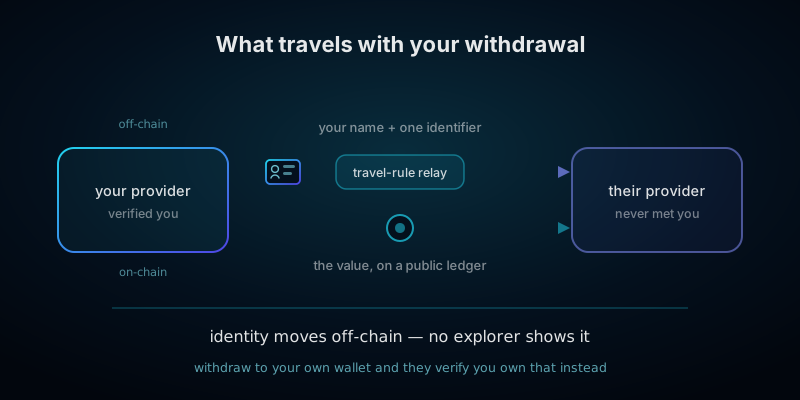
- The travel rule makes your identity move with your money. When one regulated provider sends crypto to another, it must transmit your name and at least one further identifier alongside the transfer.
- None of it is on the blockchain. The payload moves over a separate messaging channel between two companies. No block explorer shows it, and you are never shown what was sent about you.
- It is not triggered by suspicion. It applies to ordinary transfers, routinely, as a condition of the provider operating at all.
- The threshold depends on the provider licence, not on you. 3,000 dollars in the United States, 1,000 in Canada, one million won in South Korea — and since 30 December 2024, no threshold whatsoever in the European Union.
- The self-custody clause is the part that matters. Withdrawing to your own wallet has no counterparty to notify, so regulators substituted a duty to verify who owns the address. That is why exchanges now ask you to prove ownership of a wallet you already control.
- That verification is an attribution, and attribution propagates. It is the authoritative identity anchor chain-analysis tooling has always been short of, and ordinary clustering extends it to addresses you never declared.
- A stuck withdrawal is often the sunrise problem, not a fault. Jurisdictions switched the rule on at different times, and two compliance systems that cannot complete a handshake produce a pending transfer and an unhelpful error.
- The obligation sits on providers. There is nothing for an individual to file, register or report — but the downstream effects are real, permanent, and worth planning for.
This is not legal advice. The travel rule is implemented separately in every jurisdiction, thresholds and self-hosted-wallet duties differ, and the timetable keeps moving. This guide describes the mechanics that are common across most regimes as of 2026 and names dates and figures where they are settled. It is written for people trying to understand what happens to their data, not as a compliance reference — and nothing here is a route around any obligation. If a frozen balance, a formal request or an allegation is involved, take qualified local advice.
What the travel rule actually is
Most people meet the travel rule without being told its name. A withdrawal form suddenly asks whether the destination address belongs to you or to somebody else. A transfer that used to take minutes sits pending for a day. An exchange declines to send to an address it cannot attribute. These are not glitches and they are not local policy quirks — they are one international standard being implemented, unevenly, across the entire regulated crypto industry.
The rule itself is old. In 1996 United States regulators required that certain customer information accompany a funds transfer through the banking system, so that a wire arriving at a bank came with a record of who had sent it. The information had to travel with the money, and the name stuck. In June 2019 the international standard-setter for anti-money-laundering policy extended the same requirement to virtual assets, obliging providers that deal in crypto to collect and transmit originator and beneficiary information when value moves between them.
Two features of the mechanism account for most of the confusion around it.
- The data does not travel on the blockchain. This is the single most common misunderstanding, and it matters. The identity payload moves over a separate, private channel between the two companies — a messaging protocol or a commercial network that both happen to belong to. Nothing appears on-chain, no explorer reveals it, and the transaction itself looks exactly like any other. The ledger carries the value; a parallel pipe carries your name.
- It has nothing to do with suspicion. There is no threshold of dodginess to cross. The obligation is routine and unconditional above whatever monetary floor applies, and it is a condition of the provider holding its licence rather than a response to anything you did. Nobody reviews your transfer and decides to attach your identity to it; the system attaches it by default.
The perimeter is drawn around providers, not people. Exchanges, custodians, brokers, payment processors and other intermediaries that hold or transmit customer crypto are inside it. You, moving your own coins between your own wallets, are not — and no version of the rule anywhere asks an individual to file, register or disclose anything. That distinction is genuine, and it is also narrower in practice than it sounds, for reasons the rest of this guide is about.
What exactly travels with your withdrawal
The international minimum is specific, which is useful, because it means the answer does not depend on which exchange you use. When a transfer crosses between two providers, the sending side must transmit:
- Your name — the verified legal name on your account, not a username or a display name.
- The originating account or wallet address — the address the value left from, where an account is used to process the transfer.
- One further identifier for you, chosen by the provider from a fixed menu: your physical address, your national identity number, a customer identification number that uniquely identifies you to that provider, or your date and place of birth.
- The beneficiary name — whoever you said you were paying, which is your own name again when you are moving funds between your own accounts.
- The beneficiary wallet address — the destination.
Since the receiving side has to parse this automatically rather than read it, the industry converged on a shared data model, usually written IVMS101, which standardises how a name, an address and a national identifier are structured so that a compliance system in one country can process a payload generated in another. It is unglamorous plumbing, and it is the reason the payload is machine-readable and easy to store, index and search for the rest of its retention period.
Three properties of that payload are worth stating explicitly, because they are not obvious from any interface you will see:
- You do not see it and cannot edit it. There is no screen that shows the payload transmitted on your behalf. A subject access request to either company will usually surface it after the fact, which is a right worth knowing about — the guide to what happens to your identity documents covers how to make one that actually works.
- It reaches a company you have no relationship with. The receiving provider gets your name and identifier because of a transfer you made, not because you signed up with it. Its retention period, its security posture and its jurisdiction are all outside your control and usually outside your knowledge.
- It is retained, typically for five years. Anti-money-laundering recordkeeping obligations mean the payload does not expire with the transaction. Both providers hold it, as does any vendor operating the messaging layer between them.
The count adds up faster than people expect. One withdrawal produces a record at the sending provider, a record at the receiving provider, and a record at whichever intermediary carried the message — three organisations holding your verified identity alongside a specific wallet address and a specific amount, for a transfer you thought involved one company.
Thresholds: the number that decides everything
There is no global threshold, and the differences are large enough to change what happens to a given transfer entirely. The figure that applies to you is set by where your provider is licensed — not by your own residence, your citizenship, or the destination.
- The international recommendation: 1,000 dollars or euros. Countries may set a de minimis at that level, below which providers need transmit only the names and wallet addresses of both parties, without verifying the originator information. It is permission to be lighter, not an instruction, and plenty of jurisdictions declined it.
- European Union: no threshold at all. The recast Transfer of Funds Regulation, Regulation (EU) 2023/1113, has applied since 30 December 2024 and requires complete originator and beneficiary information for crypto-asset transfers regardless of value. A ten-euro transfer between two European providers carries the same identity payload as a very large one. This is currently the strictest major regime, and it is a deliberate departure from the position for conventional transfers, where a threshold survives.
- United States: 3,000 dollars. The recordkeeping and travel-rule obligation in federal regulation applies at and above that figure, and convertible virtual currency has been treated as falling within it since 2019 guidance. A 2020 proposal to lower the threshold to 250 dollars for cross-border transfers attracted heavy industry opposition and was never finalised — worth knowing, because it is frequently cited as though it were in force.
- Canada: 1,000 Canadian dollars. Applied to virtual-currency transfers since June 2021.
- Singapore: 1,500 Singapore dollars. Set by the central bank notice governing digital payment token services.
- South Korea: one million won. In force since March 2022, and notable for having driven domestic providers into shared messaging alliances in order to comply at all.
- Japan: no de minimis. The obligation applies to transfers between providers from April 2023 without a monetary floor.
- United Kingdom: in force since September 2023, with reduced information permitted below the equivalent of 1,000 euros and an explicit risk-based accommodation for transfers to jurisdictions that have not implemented the rule.
- Switzerland: strict on external wallets specifically. The regulator has for years expected providers to establish ownership of an external wallet before releasing funds to it, which made it an early preview of the self-custody question the rest of the world reached later.
Two practical notes. First, a threshold is not a privacy feature: staying under one reduces what must be verified, not whether a record exists. Second, and more importantly, deliberately splitting a transfer into pieces to stay beneath a reporting floor is a distinct offence in most regimes — structuring — and it happens to be the single pattern that automated transaction monitoring detects most reliably. Knowing where the thresholds sit is useful. Arranging your transfers around them is the one use of that knowledge that can create a genuine legal problem where none existed.
The clause that actually affects you: withdrawing to your own wallet
Everything above concerns transfers between two providers. The more consequential question is what happens when there is no second provider — when you withdraw from an exchange to a wallet whose keys you hold.
Structurally, the travel rule has nothing to send. There is no receiving institution to accept a payload, no compliance system on the far side, no counterparty at all. Regulators did not treat that as a gap to be tolerated; they substituted a different obligation. Rather than transmitting data to somebody, the provider must establish something about the destination: whose wallet it is.
In the European Union, a transfer above 1,000 euros to or from a self-hosted address requires the provider to verify that its customer controls or owns that address. Switzerland arrived at the same place earlier by a different route. Several other jurisdictions apply a risk-based version, and a good many providers apply an internal policy stricter than their regulator requires, because the cost of being wrong is asymmetric.
The methods you will actually encounter, from strongest to weakest:
- Signing a challenge message. The provider gives you a string; you sign it with the key controlling the address and return the signature. This is the correct answer cryptographically: it demonstrates control and reveals nothing else. Most competent wallets can do it, though the feature is often buried.
- A small test payment. You send a trivial amount from the address, which shows you can spend from it. Effective, slightly wasteful, and entirely reasonable.
- A screenshot of the wallet. Widely requested and close to meaningless — it demonstrates that you can operate a screenshot tool. It adds an image to your permanent file and proves nothing about control. Where it is the only option offered, that tells you something about the depth of the verification.
- A seed phrase or private key. Never. No legitimate verification process anywhere requires either, and any request for one is a compromise attempt regardless of how official the surrounding page looks. Our guide to verifying a service before you send covers the family of scams built on exactly this request.
There was a brief attempt to standardise the friendly version of this. In early 2022 a protocol for automating address-ownership proofs appeared and several well-regarded wallets shipped support for it, on the reasonable theory that a smooth cryptographic handshake beats a screenshot. The backlash was immediate and the reasoning was the interesting part: users argued that making the proof frictionless normalised the demand, and that a wallet should not help build the identity-to-address mapping regardless of how elegantly it did so. Support was withdrawn within weeks. The episode is worth remembering, because it is the clearest statement anyone has made of what is really at stake here — not the inconvenience of the verification, but what the verification creates.
Why this is really an attribution programme
The privacy cost of a travel-rule transfer is easy to state and, in isolation, modest: one more company learns your name. The cost of the self-custody verification is different in kind, and it is the thing to actually think about.
Chain analysis does not break cryptography. It reads a permanent public ledger, groups addresses into clusters that probably share an owner, and then tries to attach a real-world name to a cluster. The clustering is the easy half — the heuristics are well understood and mostly mechanical. The scarce input has always been the identity anchor: one confirmed link between a cluster and a person, from which everything else follows. Our guide to how crypto actually gets traced walks through that pipeline in detail.
A verified-ownership declaration is the highest-quality identity anchor that exists. It is not an inference or a probabilistic match; it is a customer, formally verified to a regulatory standard, asserting on the record that a specific address is theirs, held in a file that must be retained for years and produced on lawful request. Nothing a clustering heuristic produces comes close to it.
And it does not stay contained. Once one address is anchored, the ordinary heuristics extend outwards from it:
- Common-input ownership. Any transaction spending your declared address together with another output asserts that both are controlled by the same person, which pulls the second address into the anchored cluster.
- Change outputs. Spending from the declared address produces change you never declared, and change-detection heuristics are reliable enough that the new address inherits the attribution.
- Onward hops. Transfers out of the anchored cluster are visible, and an address one hop from a named cluster is not anonymous in any useful sense.
So the accurate way to think about a withdrawal form asking who owns the destination is not as a question about one transaction. It is the creation of a durable link between your legal identity and a region of the ledger that will keep growing for as long as you use that wallet. The transfer is an event. The attribution is a permanent fact that propagates on its own.
None of which makes the verification illegitimate. It makes it worth a decision in advance — which addresses you are willing to spend on it, and which you are not — rather than a form filled in quickly because a withdrawal is pending. The wallet hygiene guide is the operational counterpart, and its rules about coin control and address separation are exactly the ones that decide how far a single declaration spreads.
The sunrise problem, and the withdrawal that will not go
A withdrawal to a legitimate exchange sits pending for six hours and then fails with a message that explains nothing. Support says it is a compliance matter and cannot elaborate. Nothing is wrong with your account, the destination, or the network.
What has usually happened is the sunrise problem, and it is the most common way the travel rule reaches ordinary users as an apparent malfunction. The rule was adopted internationally but implemented nationally, on wildly different timetables. A provider in a jurisdiction that switched it on years ago must transmit data to a counterparty that may have no obligation to receive it, no system capable of accepting it, and no membership of the same messaging network. There is no universal directory and no fallback channel. The handshake simply does not complete.
Providers handle that mismatch in incompatible ways. Some collect the data, hold it, and release the transfer on a risk assessment. Some queue it for manual review, which is where the hours go. Some refuse the transfer outright rather than accept an unresolved counterparty. Some ask the customer to supply details of the receiving institution — the part users find most baffling, since a transfer to an address ought not to require an essay about the recipient.
Several consequences follow that are worth knowing before they happen to you:
- Identical transfers behave differently. The same amount to the same exchange can succeed from one provider and fail from another, because the two sit in different regulatory regimes and belong to different networks.
- Small platforms and new jurisdictions fail more often. Membership of the messaging networks is a cost, and the long tail of providers has not paid it.
- Support genuinely cannot always explain. Where a suspicion report has been filed, disclosing it to the customer is itself an offence in the United Kingdom and much of the European Union. An unhelpful answer is not always an evasive one.
- Retries make things worse. Repeated attempts after a compliance hold read as circumvention to automated monitoring. One transfer, then a question, is the better sequence.
Our troubleshooting guide covers the mechanical causes of a stalled transfer — wrong network, missing memo, underpayment, congestion. This is the cause that is not mechanical at all, and no amount of checking the address will resolve it.
Who ends up holding the record
It is worth counting the organisations, because the number is not one and the list is not visible from any interface.
- Your provider. Holds your verified identity already, and now also holds a mapping from your identity to specific destination addresses, with amounts and timestamps.
- The receiving provider. Receives your name and at least one identifier for a transfer you made to a customer of theirs — or to yourself, if that is your own account. You never contracted with them.
- The messaging layer between them. Some travel-rule traffic runs over open protocols; much of it runs through commercial networks and compliance vendors. Either way a third party processes the payload, and in the commercial case usually stores it.
- Their sub-processors. Cloud hosting, backups, monitoring, disaster recovery. Standard infrastructure, and it multiplies the number of systems a copy exists in.
- Anyone lawfully requesting it later. The record exists precisely so that it can be produced, and retention obligations mean it will still be there years after you have forgotten the transfer.
This is not an accusation of bad faith against any of them. It is the ordinary consequence of a design that requires identity to accompany value: the number of parties holding a copy of your identity grows with the number of transfers you make, through mechanisms working exactly as intended. The same observation applies to identity documents, and it is the core of the guide to what happens after you upload one — deletion is generally unavailable, because the retention is the point.
Five things people believe that are not true
- "The travel rule data is on the blockchain." It is not, anywhere. The payload moves between two companies over a private channel and appears on no ledger. Conversely, the fact that a transfer looks unremarkable on-chain says nothing about what was transmitted alongside it.
- "It only applies to large transfers." It depends entirely on the regime, and the strictest major one has no floor. Since December 2024 a very small transfer between two European providers carries the full identity payload.
- "It means I have to report my own transactions." No version of the rule places an obligation on an individual. The duties are the providers'. What reaches you is friction and a record, not a filing requirement.
- "Using a self-custodial wallet keeps me out of it." It removes the counterparty transmission and replaces it with something arguably more consequential — a verified attribution of your address to your name, retained on the record.
- "A stuck withdrawal means I did something wrong." Usually it means two compliance systems could not complete a handshake. The sunrise problem is a coordination failure between regulators, and it presents as an error message aimed at you.
What to do about it
Seven things, in order of leverage. None of them is a route around any obligation — each is about limiting how much of your financial life a routine transfer permanently describes.
- Find out which regime your provider is under. The threshold, the self-hosted-wallet duty and the refusal policy all follow from where it is licensed, not from where you live. That one fact predicts nearly everything about how your withdrawals will behave.
- Treat any address you declare as permanently attributed. A verified-ownership declaration is the strongest identity anchor in the ecosystem, and clustering will extend it to addresses you never mentioned. Decide which addresses you are prepared to spend that way before a form asks you while a withdrawal is pending.
- Keep a dedicated wallet for withdrawals from identified venues. Its only job is receiving funds whose origin was already known to a company that knows your name. That confines the attribution to coins that were never private rather than letting it reach everything you hold.
- Never consolidate attributed coins with unattributed ones. Spending two outputs together asserts common control and merges their histories irreversibly. This is the step that turns one declared address into a fully mapped wallet, and it is the one that cannot be undone.
- Prefer a signature, accept a test payment, refuse a key. A signed challenge proves control and discloses nothing else. A screenshot proves nothing and enlarges your file. A request for a seed phrase is an attack, always, whatever the page looks like.
- Withdraw in a way you can explain, and never structure around a threshold. Splitting transfers to stay under a floor is a separate offence in most regimes and is the pattern monitoring catches best. One clean transfer you can account for beats several engineered ones.
- Write down provenance on the day it arrives. Venue, date, amount, transaction identifier. A source-of-funds question can arrive years later, and a note written at the time is the difference between a resolved query and an escalated one. The guide to flagged coins covers what those questions look like when they land.
Steps two and four are the whole game, and they are the same insight in two forms: the attribution created by one form is only as large as the wallet you let it touch.
Where we sit in this, stated plainly
A guide about identity transmission published by a swap service is worthless unless it says what that service transmits. So:
- There is no originator record here to transmit. We are a non-custodial routing front end. No account, no name, no email, no phone number, no document — so the data the travel rule requires a provider to send does not exist at our layer. That is an architectural fact, not a policy we could change our mind about.
- The regulated entities are upstream. We route to third-party liquidity providers, and those providers are inside the regulated perimeter for their own operations, including screening. We are not claiming that the chain as a whole is outside regulation — only describing which part of it we are.
- International guidance on non-custodial software is genuinely unsettled. Purely non-custodial software that never controls funds can fall outside the provider definition, and the same guidance warns that anyone with sufficient control or influence over a service may be treated as a provider regardless of architecture, with interpretations differing by country. We would rather describe that as unsettled than present a convenient reading as settled law. The country-level picture is in the jurisdiction guide.
- What we hold, and for how long. Order records purge within thirty days; server logs rotate within twenty-four hours. None of it contains an identity, because none was ever collected. The specifics are itemised on the transparency page and the privacy page.
- A flagged order gets a refund offer, never a document request. Where the upstream layer flags an order, the order page asks for an address you control. Identity verification is never a precondition for getting your funds back. The policy is written out on the AML page rather than left to goodwill.
- Having used a no-KYC route can itself cost you later. Several screening databases carry a category for services like ours, and funds that later reach a conservative regulated venue can attract a source-of-funds question on that basis alone. It is a real cost of using us. We would rather you plan for it than discover it.
What we cannot do is remove you from the travel rule, and we would be suspicious of anyone who claimed otherwise. If your funds start at a regulated exchange or end at one, that leg is subject to it whatever happens in the middle. What a non-custodial route changes is whether an additional identity payload is generated in between — not whether the identified legs were identified.
Related reading
For the clustering and attribution machinery that a verified address declaration feeds, see blockchain analysis explained. For what happens to the identity documents that make the payload possible in the first place, KYC data breaches. The operational counterpart to this guide is wallet hygiene for privacy swaps, which covers the coin control and address separation that decide how far one attribution spreads. For the regulatory backdrop country by country, is no-KYC swap legal where you live; for why a disposal is taxable regardless of who reported it, the tax guide; and for what a risk score means when it lands on your deposit, tainted crypto explained. If the question underneath all of this is what a swap does and does not conceal, start with is crypto swapping anonymous. Vocabulary used throughout is defined in the glossary.