The short version
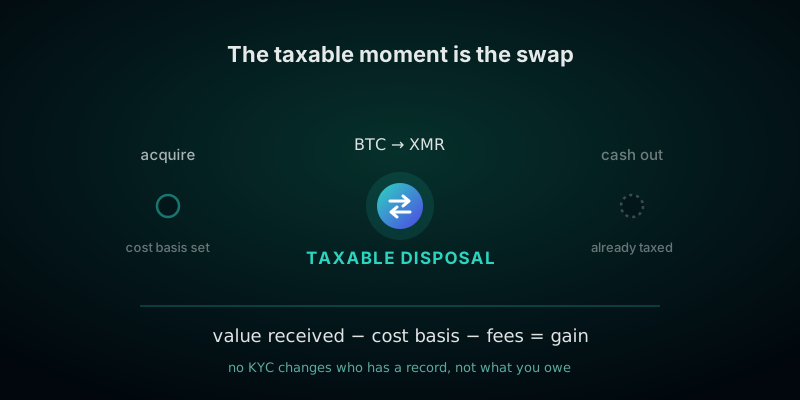
- In most countries a crypto-to-crypto swap is a taxable disposal. The instant you exchange BTC for XMR you have sold the BTC at its market value, whether or not any fiat was ever involved.
- No KYC changes who has a record, not what you owe. The identity check is an obligation imposed on the service. The tax is imposed on you, by the country you live in, and it attaches to the transaction rather than to the platform.
- A real minority of countries genuinely do not tax the swap itself — France, Portugal and Italy among them, on specific terms. Find out which side of that line you are on instead of assuming.
- The gain is measured in your own currency at the moment of the swap: value of what you received, minus the cost basis of what you sent, minus the attributable costs.
- No account means no CSV export. The one genuine operational burden of a non-custodial swap is that you are your own record keeper — and the record has to be made on the day, because a privacy-coin leg cannot be reconstructed later.
- Privacy and non-declaration are two different decisions. The first is lawful nearly everywhere. The second is not, anywhere. Conflating them is the most expensive mistake in this space.
This is not tax advice. Tax treatment of crypto-assets is jurisdiction-specific, fact-specific and changing quickly. This guide explains the mechanics that are common across most systems and summarises the position in fifteen jurisdictions as of early 2026, so that you know which questions to ask. Before filing anything, confirm the current rules with a qualified professional in your own country.
Why a swap is a sale, even when no money appears
The intuition that trips people up is a reasonable one: nothing was cashed out, no bank saw anything, the value is still sitting in crypto, so surely nothing has happened yet. That intuition is wrong in most of the world, and it is wrong for a structural reason worth understanding rather than memorising.
Almost every tax authority that has published a position treats crypto-assets as property, not as currency. Once something is property, the general rules of capital gains apply to it, and the general rule for property is that any disposal triggers a reckoning — not just a sale for cash. Giving property away, trading it for other property, and using it to pay for something are all disposals. A crypto-to-crypto exchange is a barter of one property for another, so both sides of it are transactions in the tax sense: you disposed of the first asset and you acquired the second.
The consequence is that the taxable moment is the swap, not the eventual cash-out. Someone who bought Bitcoin at $4,000, rotated it through four different assets over two years and never once touched fiat has had four disposals and may owe tax on each, even with an empty bank account and no fiat gain realised anywhere. This is also why the "I will deal with it when I cash out" plan fails so badly: by the time the fiat exit happens, the liability has already been accruing across years that may now need amending.
The one genuinely useful mental model: think of every swap as two transactions that happen at the same instant — a sale of what you sent, at the market price at that moment, and a purchase of what you received, at the same price. Once you see it that way, everything else in this guide is bookkeeping.
No KYC is not no tax
This is the section that most of the industry quietly declines to write, so let us be direct about it. KYC and taxation are unrelated obligations that people conflate because both involve the word "government".
KYC is an anti-money-laundering duty imposed on a financial intermediary: verify who your customer is, screen them against sanctions lists, report suspicious activity. Whether a given service owes that duty depends on what it does — whether it takes custody, whether it holds fiat, where it is established. A non-custodial router that never holds a balance sits differently in that framework than a custodial exchange does, which is the subject of our jurisdiction guide and our AML statement.
Tax is a duty imposed on you, personally, by the country you are tax-resident in. It arises from the transaction itself. No platform, anywhere, has the power to waive it, and no platform's compliance posture affects it. A service that does not ask for your identity has not exempted you from anything — it has declined to collect a document. Your return is still your return.
The version of this claim that circulates on forums — that unreported swaps are safe because no exchange reported them — is also weakening as a factual matter, independent of whether it was ever a good idea. Transparent chains are permanently public and permanently analysable. The overwhelming majority of crypto histories touch an identity-bearing service somewhere: the exchange where the first purchase happened, the ramp used at the end, a payment to a merchant who kept records. That single anchor point attaches a real name to an address graph that extends in both directions. Meanwhile the automatic reporting frameworks are arriving on schedule: the OECD's Crypto-Asset Reporting Framework and, in the European Union, DAC8 begin moving account data between jurisdictions from 2026, and the United States has phased in dedicated broker reporting for digital assets. The reasonable planning assumption for anything you do today is that a record exists somewhere and may become visible later.
What legitimate privacy actually buys you is different and worth stating plainly: it stops your counterparties, your ISP, chain-analysis firms, data brokers and anyone who buys their output from assembling a complete picture of your finances by default. That is a real and defensible good. It is not, and was never, an exemption from filing.
How fifteen jurisdictions treat the swap
Summarised at a level that tells you what kind of regime you are in. Thresholds and rates move every budget cycle, so treat the numbers as orientation and verify the current figure before you rely on it.
- United States — taxable. Crypto is property; a crypto-to-crypto exchange is a realisation event reported on Form 8949 and Schedule D. Short-term gains are taxed as ordinary income, long-term at capital-gains rates. Like-kind exchange treatment has not been available for crypto since the 2018 reform, and Form 1040 asks a direct digital-asset question. Broker reporting on Form 1099-DA has been phasing in, and basis is tracked per wallet or account rather than universally.
- United Kingdom — taxable. HMRC treats a crypto-to-crypto exchange as a disposal for capital gains tax, valued at the sterling market value of the tokens received. Section 104 pooling applies, along with the same-day and thirty-day matching rules. The annual exempt amount has been cut sharply in recent years, which pulls far more ordinary users into filing.
- Germany — taxable, with a long-hold exemption. Swaps are private disposals under §23 EStG. Gains on assets held longer than one year are exempt; inside the year they are taxed at your income rate above a small annual exemption. The one-year clock restarts on the asset you receive, which makes the holding-period consequence of a swap the thing to think about before executing it.
- France — generally not taxable at the swap. For private investors the taxable event is the conversion of digital assets into fiat, or their use to buy goods and services. Crypto-to-crypto exchanges sit outside that, and the gain is computed on the fiat exit under the flat regime. Habitual or professional trading is assessed differently.
- Portugal — generally deferred at the swap. A crypto-to-crypto exchange typically does not crystallise a gain; the original acquisition value carries across to the new asset. Disposals for fiat within 365 days of acquisition are taxed, and holdings beyond that period have been treated favourably. Professional activity is taxed separately.
- Italy — usually not taxable between similar assets. Exchanges between crypto-assets with equivalent characteristics and functions fall outside the disposal rules, while conversions to fiat or to a materially different asset class are taxed at a flat substitute rate.
- Spain — taxable. A permuta between crypto-assets is a disposal, taxed on the savings income scale. Spain also has significant informational reporting duties for holdings on foreign platforms, which are separate from the tax itself and carry their own penalties for omission.
- Netherlands — holdings, not swaps. Private investors are taxed under the Box 3 wealth regime on the value of their assets at the reference date rather than on realised gains, so an individual swap is not itself the taxable event. The system is under active reform toward actual returns, so this is one to re-check annually.
- Switzerland — usually exempt for private investors. Capital gains on private wealth are generally not taxed, so a swap normally has no income-tax consequence. Cantonal wealth tax applies to the value of what you hold, and classification as a professional trader changes the answer completely.
- Canada — taxable. The CRA treats crypto-to-crypto as a barter transaction and a disposal. Individuals include a portion of the capital gain in income; trading that amounts to a business is fully taxable as business income instead, and the line between the two is drawn on frequency, intention and sophistication.
- Australia — taxable. Each swap is a CGT event, valued in Australian dollars at the time of the exchange. A discount applies to gains on assets held longer than twelve months for individuals, so, as in Germany, swapping resets a clock that has real value.
- Japan — taxable as income. Gains, including crypto-to-crypto, are treated as miscellaneous income and taxed on the progressive scale rather than at a flat capital-gains rate, which puts the top marginal burden among the highest anywhere.
- India — taxable, with a transaction levy. A flat rate applies to gains on virtual digital assets with no offsetting of losses against other income, and a small tax deducted at source applies per transfer. Crypto-to-crypto is inside the regime, and the absence of loss offset makes frequent swapping structurally expensive.
- Brazil — taxable above a monthly threshold. Gains are taxed on a progressive schedule, with a monthly disposal allowance below which domestic sales are exempt, and a distinct regime for assets held abroad. Monthly reporting duties apply to significant activity.
- Singapore, UAE, Hong Kong — no personal capital gains tax. Individual investment gains are outside the tax base entirely, so the disposal question does not arise. Income from trading as a business, or from services paid in crypto, remains taxable in the ordinary way.
Two patterns are worth extracting. First, the majority position is that the swap is the event, and the exceptions are specific and conditional rather than general. Second, residence is what decides which column you are in — not the location of the service, not the chain, not where the counterparty sits. Someone tax-resident in a country that taxes swaps does not change that by routing through a service established somewhere else.
Computing the gain
The arithmetic is the same everywhere the swap is taxable, and it is simpler than the vocabulary suggests. Four inputs, one subtraction.
- Proceeds. The fair market value, in your reporting currency, of the asset you received, at the moment the swap settled. Most authorities specify the received asset because that is what you were paid; where it cannot be valued reliably, the value of what you gave up is used instead.
- Cost basis. What you originally paid for the asset you sent, in your reporting currency, including the fees you incurred acquiring it.
- Attributable costs. The sending network fee, the payout network fee, and the spread — the gap between the mid-market rate and the rate you actually executed at. Our fees guide decomposes those precisely; the same decomposition is what makes them defensible as allowable costs here.
- New cost basis. The proceeds figure becomes the acquisition cost of the asset you received. This is the step people forget, and forgetting it means paying tax twice on the same appreciation.
A worked example
Suppose you acquired 0.10 BTC for $4,200 all-in, including the fee on that purchase. Some months later you swap that 0.10 BTC for Monero. At the moment the swap settles, the XMR that lands in your wallet is worth $5,940 in your reporting currency, and your own wallet paid $4 in Bitcoin network fees to broadcast the deposit.
- Proceeds: $5,940 — the market value of the XMR received.
- Cost basis of the BTC: $4,200.
- Attributable cost: $4 sending fee.
- Taxable gain on this swap: $5,940 − $4,200 − $4 = $1,736.
- Cost basis of the XMR going forward: $5,940.
Now suppose that XMR is later swapped for stablecoins worth $6,300. The second disposal produces a gain of $360, not $2,100 — because the basis was reset at the first swap. Getting that reset right is worth more to most people than any rate optimisation they will ever do, and it is the single most common error in self-prepared crypto filings.
One nuance to record while you can. Because proceeds are measured on the received leg, the spread you paid is already reflected in a lower proceeds figure — you received slightly less value than the mid-market rate implied. Noting the mid-market rate alongside the executed rate at swap time is what lets you show the difference as a cost rather than being unable to evidence it at all.
Which units did you actually sell?
If you have bought the same asset several times at different prices, a partial disposal raises the question of which units left. The answer is set by your jurisdiction, not by preference, and it changes the number materially.
- Pooling — used in the UK, where all units of a token form a single pool with an averaged cost, adjusted on every acquisition, with special matching rules for disposals close in time to a purchase.
- FIFO — first in, first out; the default or the requirement in many European systems, and the assumption most software falls back to.
- Specific identification — permitted in the United States if you can adequately identify the units disposed of, with contemporaneous records; basis is now tracked per wallet or account rather than pooled across all of them.
- Average cost — the adjusted cost base approach used in Canada and several other systems, where every acquisition re-averages the basis of the whole holding.
Two practical consequences. Whichever method applies to you, apply it consistently across all years — switching methods to produce a better answer is exactly the pattern an audit looks for. And in a per-wallet regime, moving coins between your own wallets does not create a disposal but it does move the basis, so a transfer that was invisible for tax purposes can still change which units a later swap consumed.
Being your own record keeper
Here is the honest trade-off of using a service with no account. A custodial exchange will hand you a CSV at year end because it built a database about you in order to be able to. A non-custodial swap has no account, no history and nothing to export, which is the privacy property you came for — and the direct cost of it is that the record has to be yours.
That cost is small if you pay it on the day and large if you defer it. Order pages on non-custodial services expire, single-use deposit addresses are retired after settlement, and historical prices for thin pairs get harder to source with every month that passes. For a leg involving Monero or any shielded asset there is no public explorer to fall back on at all: if you did not write it down, the transaction is genuinely unreconstructable from outside your own wallet.
Capture these fields for every swap, in one place:
- Date and time of settlement, to the minute, with the timezone.
- Sent: asset, exact amount, source wallet, and the transaction hash if the chain is transparent.
- Received: asset, exact amount, destination wallet, and its transaction hash where one exists.
- Value of both legs in your reporting currency at that timestamp, plus the name of the price source you used.
- Fees: the sending network fee your wallet paid, the payout network fee, and the mid-market rate at execution so the spread can be reconstructed.
- Order identifier and a screenshot or saved copy of the completed order page.
- Purpose, in a few words. "Rotating BTC into XMR for savings" is worth a great deal three years later when you no longer remember and someone is asking.
A spreadsheet is entirely sufficient and is what most people should use. Keep one chronological ledger covering every wallet rather than one file per wallet, store it in at least two places, and price everything from the same source across all years so the methodology is consistent. If you route swaps through a service that also gives you a durable order reference, save it — our order pages are designed to be saved and re-opened, and the order status guide explains what each state means.
On tooling: the mainstream crypto tax packages ingest exchange APIs and public chain data. They handle transparent-chain legs of a non-custodial swap reasonably well, since both sides are ordinary on-chain transactions, but they cannot see a shielded leg and they will frequently label an unmatched send as a disposal at zero basis, which produces a far larger bill than you actually owe. Whatever software you use, expect to correct the swap legs by hand from your own ledger. That ledger is the primary record; the software is a convenience over it.
The privacy-coin evidence problem
Swapping into Monero creates no special tax problem and a very specific evidence problem, and the two get confused constantly.
The tax treatment is unremarkable. Monero is property like any other crypto-asset; the disposal that funded it is taxed exactly as it would have been had you bought Ethereum. Holding it is lawful in the large majority of jurisdictions — the jurisdiction guide covers the handful of places with delisting pressure or restrictions — and no revenue authority infers anything from the asset choice alone.
The evidence problem is real. For a transparent asset, an auditor questioning your cost basis can be pointed at a block explorer, and the chain corroborates your claim independently. For a shielded asset, that corroboration does not exist. Your own contemporaneous records are the entire evidential base — and remember that the person most likely to be harmed by weak records is you, because it is the cost basis you would be unable to prove. An unproven basis tends to be treated as zero, which turns a modest gain into a taxable amount equal to the full proceeds.
Three habits close the gap without giving up the privacy. Keep the wallet's own transaction record and its view key backed up, since that is what lets you demonstrate receipt of a specific amount at a specific time without publishing anything. Write the swap into your ledger the same day, with the order reference. And keep the transparent leg's hash — a BTC → XMR swap has a fully public Bitcoin side, which independently establishes what left, when, and at what value, even if the receiving side is private. Our wallet hygiene guide covers the operational side of holding these assets well.
The seven expensive mistakes
- Believing no KYC means no filing. The most costly assumption in the space, and the one that compounds silently across years until an amendment covers all of them at once.
- Forgetting to reset the cost basis after a swap, and paying tax on the same appreciation twice. Pure self-inflicted overpayment, and extremely common.
- Not recording losses. Losses generally offset gains, and in some systems carry forward indefinitely. Users who only record the profitable swaps consistently overpay. In a few regimes — India most conspicuously — offsetting is not permitted at all, which is worth knowing before you plan around it.
- Treating a wallet-to-wallet transfer as a disposal. Moving your own coins between your own wallets is not a taxable event anywhere. Software mislabels these constantly when it cannot see both sides.
- Ignoring the holding-period clock. In Germany, Australia and every regime with a long-hold benefit, a swap resets the timer on the new asset. Swapping the week before a threshold is reached is an avoidable and sometimes very large cost.
- Pricing inconsistently. Using whichever source gives the friendlier number, or valuing at the order-creation time on one swap and the settlement time on another. Pick one method, document it, apply it everywhere.
- Leaving it until the cash-out. By then the liability spans several closed tax years, the order pages are gone, and the reconstruction costs more in professional fees than the tax would have.
Where the legal line actually sits
Worth stating precisely, because the distinction is what keeps a legitimate privacy practice legitimate.
Using a non-custodial, no-KYC swap is lawful in most jurisdictions. Holding privacy coins is lawful in most jurisdictions. Declining to publish your financial history to third parties is lawful everywhere. None of these facts is in tension with tax compliance, and you can do all three while filing an accurate return — which is, in fact, the position most privacy-conscious crypto users are in.
Deliberately omitting taxable disposals from a return is tax evasion, and it is a criminal offence in essentially every jurisdiction that has an income tax. It does not become something else because the transaction was private, and privacy tooling used to conceal it is generally treated as an aggravating fact rather than a mitigating one. The distinction has nothing to do with the technology used and everything to do with what appears on the return.
The coherent position — and the one this site is built around — is that privacy is about who gets to see your finances by default, not about whether you meet your obligations. Your ISP, your counterparties, chain-analysis vendors and anyone who buys their data are not entitled to your complete financial history. Your revenue authority is entitled to an accurate return. Those two claims are perfectly compatible, and anyone selling you the idea that the first one dissolves the second is selling you a liability.
What we can and cannot do for you
Stated as plainly as the rest of it. We have no account system, so there is no history to export and no year-end statement to send you — that is a direct and deliberate consequence of the same design that means we hold no identity and no balances, documented on our transparency page and our privacy page. If you need a tax report, you are building it yourself from the ledger described above.
What the architecture does give you is a workable set of primitives. Every order has an identifier and an order page you can save at the moment it completes. Both legs are ordinary on-chain transactions with real hashes on transparent chains, which is independently verifiable evidence that stands on its own. The quote is visible before you commit, so the executed rate can be recorded against the mid-market rate at the same instant. And we do not retain a profile of your activity, which means the record you keep is the authoritative one rather than a copy of ours.
We cannot tell you what you owe. That depends on your residence, your holding periods, your acquisition history and your other income, and nobody who has not seen all four should be answering it. What we can do is not pretend the question does not exist — which is more than most of this industry manages, and it is the same standard we apply on what a swap actually conceals and on where we lose to competitors.
Related reading
For the regulatory position on the swap itself rather than the tax on it, see is no-KYC crypto swap legal where you live. For the decomposition of spread, platform fee and network fee that determines your allowable costs, see crypto swap fees explained. For what a swap does and does not conceal, see is crypto swapping anonymous. For the fiat exit and the reporting that attaches to each route, see how to cash out crypto without KYC. For the operational hygiene behind holding these assets, see wallet hygiene for privacy swaps, and for the vocabulary used throughout, the glossary.